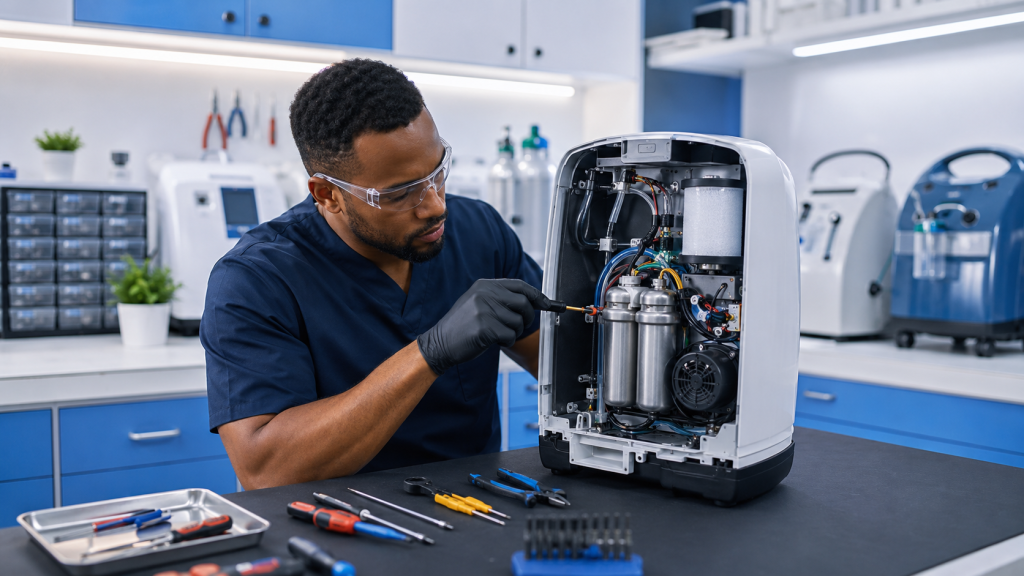
An oxygen concentrator is not an appliance. It is a medical device that a patient’s breathing depends on — often 24 hours a day, seven days a week. When it starts to under-perform, the consequence is not inconvenience. It is clinical.
Yet most oxygen concentrators in South African homes have never been serviced. They run for years, pulling in dusty Highveld air, until one day the purity alarm sounds, the flow drops, or the unit simply refuses to switch on.
This guide explains how concentrators fail, what an oxygen concentrator repair actually involves, when servicing is due, and how to avoid buying a replacement machine when a repair would have done the job. It is written by the technicians at Oxyfix — the dedicated repair division of Oxymed SA, a SAHPRA-licensed medical oxygen supplier.
If your machine is already faulty, skip ahead and book an oxygen concentrator repair.
A concentrator draws in ambient air and forces it through molecular sieve beds packed with zeolite, which trap nitrogen and release concentrated oxygen. This is Pressure Swing Adsorption, and it depends on three things staying healthy: clean air going in, a compressor holding pressure, and sieve material that has not been contaminated by moisture.
South African conditions attack all three.
A machine that would comfortably run 20,000 hours in Munich often needs attention far sooner here. Regular oxygen concentrator servicing is what closes that gap — and our guide to oxygen concentrator maintenance covers what you can do yourself between services.
People use the words interchangeably, and it costs them money.
A service is scheduled preventative work on a machine that still functions — filters, purity check, clean, safety test. A repair is corrective work on a machine that has already failed. Servicing is cheap and predictable. Repairs are neither.
The pattern we see constantly: a patient skips servicing for four years to save money, the sieve beds slowly saturate, purity drifts down unnoticed, the compressor works harder to compensate, and eventually both fail together. The repair bill then exceeds what eight services would have cost — and the patient was under-oxygenated for months without knowing it.
If you are not sure which side of the line your machine is on, our post on the warning signs your oxygen concentrator needs servicing walks through the symptoms in detail. Purity alarms, dropping flow, new noise, overheating and a machine that will not start are all reasons to book in now rather than later.
There is a real difference between “someone had a look at it” and a proper service. Every Oxyfix oxygen concentrator service covers:
That last point matters more than people expect. If you are a frail care facility, hospital, step-down unit or home care agency, that report is your compliance record. Ask for it every time — from us or from anyone else.
Not every machine is worth saving, and any workshop that tells you otherwise is selling something.
Oxyfix gives you the numbers before the work starts, not after. If the honest answer is “replace”, we say so — and we will help you source a suitable unit rather than let you fund a repair that will not last the year. Our guide on how to choose the right oxygen concentrator is the place to start, and you can compare current stock of home oxygen concentrators, portable oxygen concentrators and lower-cost reconditioned oxygen concentrators at Oxymed.
Portable units — Inogen, Philips, AirSep, Caire, DeVilbiss — use pulse-dose delivery and a far more compact architecture. The common failure points differ:
The diagnostic discipline is the same — analyser, pressure, current draw — but the parts pipeline is tighter, so bring these in early. Book a portable oxygen concentrator repair and we will courier it in.
Manufacturer manuals typically say annually. Our field data in South Africa says it depends heavily on how and where the machine runs.
| Usage profile | Recommended service interval |
|---|---|
| Home use, under 8 hrs/day, low-dust area | Every 12 months |
| Home use, 24/7 continuous therapy | Every 6 months |
| Dusty or coastal environment | Every 6 months |
| Frail care, hospital or rental fleet | Every 6 months, plus quarterly purity spot-checks |
| Portable concentrator, frequent travel | Every 12 months, battery check every 6 |
Between services, the owner’s job is simple: wash the cabinet filter weekly, keep the unit 30cm clear of walls and curtains, never run it under a bed or behind a couch, and use a surge protector.
We also service CPAP and BiPAP machines. For replacement equipment, consumables and oxygen accessories such as cannulas, tubing and humidifier bottles, our parent company Oxymed carries full stock with nationwide delivery.
It depends entirely on the fault. Filter and fan work sits at the low end; a compressor or dual sieve bed replacement sits at the high end. Oxyfix quotes after diagnosis, and the quote is fixed — no surprises at collection.
Most services and repairs are completed within 1–3 working days, excluding courier time and subject to parts availability. Loan units are available for qualifying cases so oxygen therapy continues uninterrupted.
Yes. We repair and service all major brands of home and portable oxygen concentrators regardless of where the unit was purchased.
The definitive test is a purity reading on a calibrated oxygen analyser. If purity sits below 85% at the prescribed flow once filters and leaks have been ruled out, the sieve beds are the prime suspect.
No. Servicing by a qualified medical device technician protects your warranty. Neglecting servicing is what typically voids it.
Yes. We arrange courier collection and return delivery anywhere in South Africa at R250 per trip, or you are welcome to drop off and collect directly.
If your concentrator is alarming, struggling, or has never been serviced, do not gamble with a patient’s therapy. Certified technicians, genuine parts, 1–3 day turnaround, loan units and nationwide courier collection.
Call us on 010 006 5651 or +27 82 976 2215, email info@oxyfix.co.za, or book your service online.
Your oxygen concentrator runs silently in the background, day after day, delivering the therapy you depend on. But like any mechanical device, it can develop problems over time — and because oxygen therapy is critical to your health, identifying early warning signs could make all the difference.
Here are five signs that your concentrator urgently needs a professional service, according to the technicians at Oxyfix.
Most concentrators are designed to alert you when oxygen purity drops below 85–87%. If this alarm is going off, it is not something to reset and ignore. It indicates that the molecular sieve beds — the core of your device’s oxygen-generating system — may be exhausted or contaminated.
Low oxygen purity is a serious health risk, particularly for patients with COPD, pulmonary fibrosis, or heart failure. Book a service immediately if this alarm activates.
A healthy concentrator produces a consistent, low hum. If you notice:
These sounds should never be dismissed. Left unaddressed, a failing compressor can cause a complete breakdown and may cost significantly more to repair.
Oxygen concentrators generate heat during normal operation, but they should not feel excessively hot to the touch. Overheating typically points to a blocked air filter, restricted ventilation, or an overworked compressor.
If the unit is hot enough to make you uncomfortable touching the casing, or if it shuts itself off due to thermal protection, stop using it and have it inspected.
If you feel less airflow through your cannula than usual, or need to turn the flow rate higher than prescribed to feel comfortable, your concentrator’s output may have dropped. This can result from a blocked filter, degraded sieve beds, or a failing compressor.
Never simply increase your flow setting without investigating the cause — and never adjust your prescribed flow rate without consulting your doctor.
Even if your concentrator appears to be working fine, the absence of symptoms does not mean everything is healthy internally. Sieve beds degrade gradually, and oxygen purity can drop slowly below safe levels without triggering an alarm until the problem is severe.
The standard recommendation for most home concentrators is a full professional service every 6–12 months, or every 2,000 hours of use — whichever comes first.
If you have noticed any of the above signs, do not delay. Oxyfix offers fast, professional repairs across South Africa with a 1–3 working day turnaround on most services. We also provide loan units so your therapy is uninterrupted while your machine is with us.
Book your service online or call us directly. Your health is too important to wait.
Your oxygen concentrator is one of the most important medical devices in your home. Whether you rely on it around the clock or only during sleep, keeping it properly maintained is essential — not just for the device’s longevity, but for your health and safety. Neglecting regular care can lead to reduced oxygen purity, unexpected breakdowns, and costly repairs.
At Oxyfix, we service hundreds of oxygen concentrators across South Africa every year. Here are the seven maintenance habits our technicians recommend most.
The air intake filter is your concentrator’s first line of defence against dust and airborne particles. A clogged filter forces the compressor to work harder, reducing efficiency and potentially shortening the motor’s lifespan.
How to do it: Remove the filter panel (usually on the side or back), gently wash the foam filter in warm soapy water, rinse thoroughly, allow it to air-dry completely, and reinsert. Never run the machine with a wet filter.
Dust and household grime can accumulate on vents and surfaces, restricting airflow. Use a slightly damp cloth to wipe down the outside of the unit weekly. Avoid harsh chemical cleaners or spraying liquids directly onto the device.
Oxygen concentrators need good airflow to function efficiently. Ensure at least 30 centimetres of clear space on all sides of the unit. Avoid placing it in enclosed cabinets, near curtains, or in rooms with poor ventilation.
Inspect your oxygen tubing and nasal cannula every day for cracks, kinks, or blockages. Replace the cannula every two to four weeks, or sooner if you notice any damage. Kinked tubing reduces oxygen flow even when the machine is performing normally.
Most modern concentrators have a purity alarm or indicator light. If yours alerts you to low oxygen output, do not ignore it. Reduced purity (below 87%) can mean the molecular sieve beds are exhausted and require professional replacement — something only a qualified technician should perform.
Note down the machine’s running hours, any unusual sounds, and the dates of your at-home cleaning. This information is invaluable when booking a professional service — it helps technicians diagnose issues faster and keeps your warranty valid with most manufacturers.
Even with diligent home care, your concentrator needs professional attention at least once a year. A qualified technician will replace sieve beds, check compressor pressure, test oxygen output, and inspect internal components that are inaccessible to end users.
At Oxyfix, our standard service includes a full 14-point inspection, genuine replacement parts, and a written report. Most services are completed within 1–3 working days, and loan units are available so your therapy is never interrupted.
Maintaining your oxygen concentrator doesn’t require technical skills — just consistent habits and the right professional support. Follow these seven steps and your device will deliver reliable, safe oxygen therapy for years to come.
Need a service? Contact Oxyfix today and let our certified technicians take care of the rest.
Being prescribed oxygen therapy can feel overwhelming, especially when you are faced with a range of unfamiliar equipment options. The right oxygen concentrator depends on your medical needs, lifestyle, living situation, and budget — and making the wrong choice can affect your health and quality of life.
This guide is designed to give patients, caregivers, and healthcare professionals a clear framework for selecting the most appropriate device. At Oxyfix, we work with all major brands and models, so our advice is based on experience rather than a sales agenda.
These are the standard choice for patients who require oxygen therapy primarily at home. They plug into the wall and deliver a continuous, reliable flow of oxygen — typically between 1 and 10 litres per minute (LPM).
Best for: patients with high oxygen requirements, continuous therapy users, palliative care, and retirement or care facilities.
Common models: Philips Respironics EverFlo, Invacare Platinum, DeVilbiss 5-litre series.
Portable concentrators are battery-powered and designed for active patients who need oxygen on the go. They are smaller, lighter, and FAA-approved for airline travel. Most operate on a pulse-dose delivery system, though some offer continuous flow at lower rates.
Best for: active patients, frequent travellers, and those requiring supplemental oxygen only during exertion.
Common models: Inogen One G5, Philips Respironics SimplyGo, Caire FreeStyle Comfort.
This is one of the most important distinctions to understand:
Always confirm with your pulmonologist or respiratory therapist which delivery mode has been prescribed before purchasing or renting a device.
Your prescribed flow rate (measured in LPM) will largely determine which device is appropriate. Most home concentrators deliver 1–5 LPM, while high-flow models reach 8–10 LPM for patients with more severe needs.
Never purchase a device that cannot meet your prescribed flow rate, even during peak demand such as activity or sleep.
Cost is a real consideration for South African patients, many of whom fund oxygen therapy out of pocket or through medical aid schemes with limited benefits. A professionally refurbished concentrator from a reputable provider can offer significant savings without compromising safety — provided it has been properly serviced and tested.
At Oxyfix, any refurbished unit we supply has undergone a full 14-point inspection, with certified oxygen purity output and new sieve beds where necessary. We provide a written condition report with every unit.
Questions to ask before buying refurbished:
Before finalising your choice, confirm the following with your prescribing physician:
Whichever device you choose, regular professional servicing is non-negotiable. Oxygen concentrators are medical devices, and their output degrades over time. At Oxyfix, we recommend a full service every 6–12 months or every 2,000 hours of operation.
We service all major brands across South Africa, with nationwide courier collection, 1–3 day turnaround, and loan units available while your device is with us.
Choosing the right oxygen concentrator comes down to three things: your medical prescription, your lifestyle, and the quality of after-sales support you can access. Get the first two right with your healthcare team, and let Oxyfix take care of the third.
Have questions about a specific model or need advice on servicing your existing device? Get in touch with our team — we are always happy to help.
imunify-bot-check