
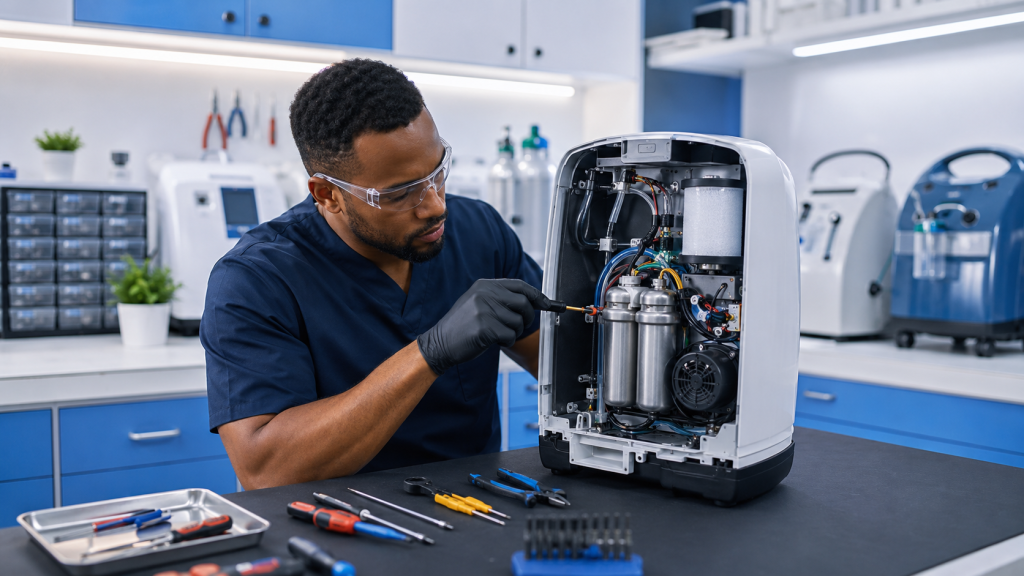
An oxygen concentrator is not an appliance. It is a medical device that a patient’s breathing depends on — often 24 hours a day, seven days a week. When it starts to under-perform, the consequence is not inconvenience. It is clinical.
Yet most oxygen concentrators in South African homes have never been serviced. They run for years, pulling in dusty Highveld air, until one day the purity alarm sounds, the flow drops, or the unit simply refuses to switch on.
This guide explains how concentrators fail, what an oxygen concentrator repair actually involves, when servicing is due, and how to avoid buying a replacement machine when a repair would have done the job. It is written by the technicians at Oxyfix — the dedicated repair division of Oxymed SA, a SAHPRA-licensed medical oxygen supplier.
If your machine is already faulty, skip ahead and book an oxygen concentrator repair.
Why Oxygen Concentrator Servicing Is Not Optional in South Africa
A concentrator draws in ambient air and forces it through molecular sieve beds packed with zeolite, which trap nitrogen and release concentrated oxygen. This is Pressure Swing Adsorption, and it depends on three things staying healthy: clean air going in, a compressor holding pressure, and sieve material that has not been contaminated by moisture.
South African conditions attack all three.
- Dust. Gauteng, the Karoo and much of the Free State are dry and dusty. Filters clog far faster than European service intervals assume.
- Humidity. Coastal homes in Cape Town, Durban and Gqeberha drive moisture into sieve beds, permanently degrading the zeolite.
- Load shedding. Repeated hard cuts and surges are brutal on compressors, control boards and power supplies.
- Altitude. Johannesburg sits at roughly 1,750m. Lower atmospheric pressure means the compressor works harder for the same output.
A machine that would comfortably run 20,000 hours in Munich often needs attention far sooner here. Regular oxygen concentrator servicing is what closes that gap — and our guide to oxygen concentrator maintenance covers what you can do yourself between services.
Is It a Service or a Repair? Know the Difference
People use the words interchangeably, and it costs them money.
A service is scheduled preventative work on a machine that still functions — filters, purity check, clean, safety test. A repair is corrective work on a machine that has already failed. Servicing is cheap and predictable. Repairs are neither.
The pattern we see constantly: a patient skips servicing for four years to save money, the sieve beds slowly saturate, purity drifts down unnoticed, the compressor works harder to compensate, and eventually both fail together. The repair bill then exceeds what eight services would have cost — and the patient was under-oxygenated for months without knowing it.
If you are not sure which side of the line your machine is on, our post on the warning signs your oxygen concentrator needs servicing walks through the symptoms in detail. Purity alarms, dropping flow, new noise, overheating and a machine that will not start are all reasons to book in now rather than later.
What a Professional Oxygen Concentrator Service Includes
There is a real difference between “someone had a look at it” and a proper service. Every Oxyfix oxygen concentrator service covers:
- Oxygen purity testing with a calibrated analyser across the full flow range — the single most important measurement, and the one most often skipped.
- Flow rate verification against the flowmeter and the patient’s prescription.
- Full filter replacement — gross particle, cabinet and internal HEPA/bacteria filters.
- Compressor inspection — pressure output, current draw, noise profile, mount condition.
- Sieve bed assessment, with replacement where zeolite is contaminated or exhausted.
- Valve and solenoid testing — the quiet culprit behind most purity faults.
- Electrical safety and leakage testing.
- Alarm verification — an alarm that does not fire is more dangerous than no alarm at all.
- Deep clean and cabinet sanitisation.
- A written service report with purity readings, hour meter, work performed and parts fitted.
That last point matters more than people expect. If you are a frail care facility, hospital, step-down unit or home care agency, that report is your compliance record. Ask for it every time — from us or from anyone else.
Repair or Replace? An Honest Framework
Not every machine is worth saving, and any workshop that tells you otherwise is selling something.
Repair makes sense when:
- The unit is under roughly 15,000–20,000 running hours
- Parts are still supported by the manufacturer
- The fault is filters, valves, a fan, a board or a single sieve bed
- Total repair cost sits under about 40% of a replacement unit
Replacement makes more sense when:
- The hour meter is very high and multiple subsystems are failing
- Compressor and sieve beds are both gone
- The model is discontinued with no parts pipeline
- The oxygen prescription has changed and needs a higher-output machine
Oxyfix gives you the numbers before the work starts, not after. If the honest answer is “replace”, we say so — and we will help you source a suitable unit rather than let you fund a repair that will not last the year. Our guide on how to choose the right oxygen concentrator is the place to start, and you can compare current stock of home oxygen concentrators, portable oxygen concentrators and lower-cost reconditioned oxygen concentrators at Oxymed.
Portable Oxygen Concentrator Repair Is a Different Animal
Portable units — Inogen, Philips, AirSep, Caire, DeVilbiss — use pulse-dose delivery and a far more compact architecture. The common failure points differ:
- Battery degradation. Lithium cells lose meaningful capacity after 300–500 cycles. A portable that used to run four hours and now runs one usually does not need a repair — it needs a battery.
- Column (sieve) failure. Portable columns are smaller and far less forgiving of humidity than home-unit sieve beds.
- Conserver and trigger faults. The unit stops detecting the patient’s breath reliably and bolus delivery goes erratic. Patients describe this as “it feels like it is not giving me anything”.
- Charging port and PCB damage. Travel wear, drops and vehicle chargers take their toll.
The diagnostic discipline is the same — analyser, pressure, current draw — but the parts pipeline is tighter, so bring these in early. Book a portable oxygen concentrator repair and we will courier it in.
How Often Should You Service an Oxygen Concentrator?
Manufacturer manuals typically say annually. Our field data in South Africa says it depends heavily on how and where the machine runs.
| Usage profile | Recommended service interval |
|---|---|
| Home use, under 8 hrs/day, low-dust area | Every 12 months |
| Home use, 24/7 continuous therapy | Every 6 months |
| Dusty or coastal environment | Every 6 months |
| Frail care, hospital or rental fleet | Every 6 months, plus quarterly purity spot-checks |
| Portable concentrator, frequent travel | Every 12 months, battery check every 6 |
Between services, the owner’s job is simple: wash the cabinet filter weekly, keep the unit 30cm clear of walls and curtains, never run it under a bed or behind a couch, and use a surge protector.
Why Choose Oxyfix for Oxygen Concentrator Repairs
- SAHPRA-licensed parent company. You are not handing a medical device to a general electronics shop.
- All major brands serviced — Inogen, Philips Respironics, DeVilbiss, AirSep, Caire, Longfian, Yuwell, Owgels and more.
- 100% genuine, medical-grade parts — including real sieve bed stock, not improvised substitutes.
- Calibrated purity testing on every unit, with a written report.
- 1–3 working day turnaround on most services.
- Nationwide courier pickup and delivery at R250 per trip.
- Loan units available for continuous-therapy patients, so treatment never stops.
- 500+ devices serviced for patients, clinics, retirement facilities and hospitals across South Africa.
We also service CPAP and BiPAP machines. For replacement equipment, consumables and oxygen accessories such as cannulas, tubing and humidifier bottles, our parent company Oxymed carries full stock with nationwide delivery.
Frequently Asked Questions
How much does oxygen concentrator repair cost in South Africa?
It depends entirely on the fault. Filter and fan work sits at the low end; a compressor or dual sieve bed replacement sits at the high end. Oxyfix quotes after diagnosis, and the quote is fixed — no surprises at collection.
How long does an oxygen concentrator repair take?
Most services and repairs are completed within 1–3 working days, excluding courier time and subject to parts availability. Loan units are available for qualifying cases so oxygen therapy continues uninterrupted.
Can you repair a concentrator I did not buy from Oxymed?
Yes. We repair and service all major brands of home and portable oxygen concentrators regardless of where the unit was purchased.
How do I know if my sieve beds need replacing?
The definitive test is a purity reading on a calibrated oxygen analyser. If purity sits below 85% at the prescribed flow once filters and leaks have been ruled out, the sieve beds are the prime suspect.
Does servicing void my warranty?
No. Servicing by a qualified medical device technician protects your warranty. Neglecting servicing is what typically voids it.
Do you collect oxygen concentrators nationwide?
Yes. We arrange courier collection and return delivery anywhere in South Africa at R250 per trip, or you are welcome to drop off and collect directly.
Book Your Oxygen Concentrator Repair Today
If your concentrator is alarming, struggling, or has never been serviced, do not gamble with a patient’s therapy. Certified technicians, genuine parts, 1–3 day turnaround, loan units and nationwide courier collection.
Call us on 010 006 5651 or +27 82 976 2215, email info@oxyfix.co.za, or book your service online.
Fast turnaround, certified technicians, and loan units available across South Africa.